Your Data Is Your Property: What a Supreme Court Concurrence Reveals About the Future of Digital Privacy



By Yaya J. Fanusie
Global Head of Policy at Aleo
Last month, the Supreme Court ruled that geofence warrants — court orders compelling tech companies to hand over location data for every device near a crime scene — constitute Fourth Amendment searches. Most headlines will focus on what this means for law enforcement (LE). But for those thinking about digital payments and financial privacy, the more consequential passage in Chatrie v. United States isn't in the majority opinion. It's in a solo concurrence that most readers will skip.
The Case
In 2019, police investigating a Virginia bank robbery obtained a warrant directing Google to search its Location History database — a continuous, precise record of where users' phones have been — and identify devices present near the crime scene. Google ultimately handed over three users' identifying information. One was Okello Chatrie, who was convicted.
The Supreme Court ruled 6-3 that accessing that location data was a Fourth Amendment "search," requiring a warrant. This is the first time the Court has considered how Location History — the continuous digital trail most of us generate simply by carrying a smartphone — fits under the Fourth Amendment. But the ruling is only half the question. Whether the warrant used here was actually valid, meaning it met the Constitution's requirements of probable cause and particularity, goes back to the lower court. The Court established that this kind of data deserves constitutional protection, but left for another day whether the specific warrant used here actually provided it.
The Doctrine That Won't Die
To understand why this all matters, you need a brief detour into something called the third-party doctrine.
Since the 1970s, courts have held that information you share with a third party — a bank, a phone company, a tech platform — loses Fourth Amendment protection. The logic: you "voluntarily" disclosed it, so you assumed the risk the third party might share it with the government. No warrant needed; a subpoena suffices. This doctrine traces directly to United States v. Miller (1976), a Bank Secrecy Act case in which the Supreme Court held that a bank customer had no Fourth Amendment right in his own financial records held by his bank. The third-party doctrine was born in a financial privacy case — a fact worth keeping in mind.
In 2018, Carpenter v. United States cracked this doctrine — but didn't break it. The Court held that cell-site location data was "qualitatively different" from bank records or phone logs, too revealing and too unavoidable to fall under the old rule. But rather than revisiting the doctrine itself, the Court carved out an exception and moved on.
Chatrie repeats that move. Google's Location History is even more precise than cell-site data, the majority says, so it gets the same exception. The third-party doctrine lives on, a little more hollowed out than before.
The Concurrence Worth Reading
Justice Gorsuch agreed that Chatrie should win. But he rejected the majority's reasoning entirely — which is why he filed a concurrence in the judgment rather than the opinion. He thinks the Court keeps arriving at the right destination by the wrong route, and that eventually the map needs to change.
His argument is straightforward: Chatrie's Location History was his property. Under Google's own terms, Chatrie could view it, edit it, export it, and delete it from Google's servers at will. Google promised to protect it from unauthorized access. Those are property rights. The fact that Google stored the data on its servers doesn't change that — any more than handing your car keys to a valet transfers ownership of your car.
Under the Fourth Amendment's original text, Gorsuch argues, the government needs justification to search your "papers and effects." Digital data that you own and control is an effect. The analysis should start — and largely end — there, without asking whether a judge thinks your privacy expectation was "reasonable."
Justice Kagan's majority pushes back, briefly but pointedly. In a footnote, she notes the Court has applied a reasonable-expectation of privacy framework (arising from a 1967 case) for 60 years and isn't abandoning it now. Property norms already inform privacy expectations, she writes — the convergence Gorsuch points to doesn't mean the privacy approach is "groping toward" the property one.
Gorsuch's closing response is the sharpest line in the whole opinion: look carefully at what the majority actually does, he says, and you'll find property analysis dressed in privacy language. The majority protects Location History precisely because users understand it as their own, even when stored on Google's servers. That's the property framework. The majority just won't call it that.
One justice, writing alone, not binding law. But a thread worth watching.
The False Choice
The majority and the principal dissent — Justice Alito, joined partly by Justice Barrett — share a hidden assumption: that effective law enforcement and meaningful digital privacy are in tension, and courts must manage that tension by deciding how much of the third-party doctrine survives.
Alito would keep it largely intact. Chatrie voluntarily enabled Location History; Google disclosed it; no warrant needed. Barrett, writing separately, agrees: under existing precedent including Carpenter, Chatrie had no reasonable expectation of privacy in data about his public movements that he chose to share with Google.
Both positions assume that LE access to third-party data is the baseline, and that privacy protection means limiting that access. But that assumption is increasingly outdated — and not just as a matter of legal theory.
Architecture as the Answer
Consider what happened before Chatrie was even decided. Apple had long since made the geofence-warrant question moot for its users: it doesn't store location history on its servers in searchable form, so it has nothing to hand over. Google followed in 2023, migrating Location History to users' devices with end-to-end encryption. As the Chatrie opinion notes in a footnote, Google now represents that it can no longer respond to geofence warrants at all.
Two of the largest technology platforms in the world resolved the legal question through architecture before the Court resolved it through doctrine.
The same logic applies to financial transaction data — and this is where the Chatrie conversation connects directly to the future of digital payments.
Zero-knowledge proof (ZKP) technology allows a user to transact on shared infrastructure while retaining genuine control over what is disclosed and to whom. The underlying data — who transacted, when, with whom, for how much — doesn't have to be visible to the infrastructure provider by default. Disclosure can be selective and proportional: triggered by lawful process, scoped to what's actually needed, rather than extracted from a centralized database built for a different purpose.
I have no idea if Justice Gorsuch knows anything about ZKPs, but this is what his property framework looks like in practice. The user retains the rights to their transaction data even when it lives on third-party rails. Entrusting data to infrastructure for limited purposes — to move value, to settle a payment — doesn't mean surrendering ownership of it.
And critically, this isn't privacy from compliance. It's privacy with compliance. Selective disclosure under ZKP means law enforcement with lawful process can reach specific transactions or users. What it can't do is run a dragnet — and the Chatrie majority's entire concern, across 33 pages, is precisely that dragnets are what the Fourth Amendment was designed to prevent.
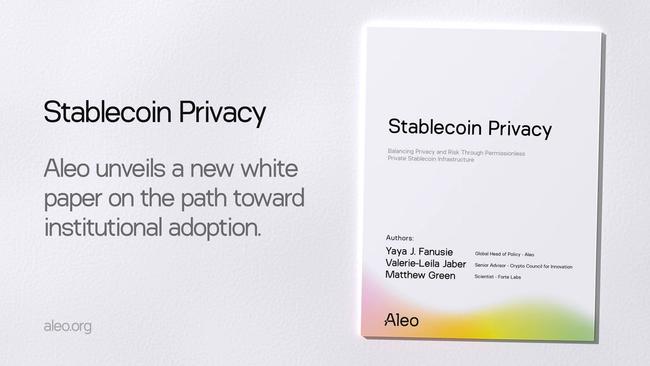
Private stablecoins like USDCx and USAD, built on Aleo's zero-knowledge architecture, are designed around this principle, as discussed in our recent white paper, Stablecoin Privacy.
Where This Points
The law is still catching up to the digital world. Chatrie advances that project — establishing that your location data is constitutionally protected even when a tech company holds it — without completing it. The warrant validity question goes back to the lower court. The third-party doctrine remains formally intact, just increasingly riddled with exceptions. And Gorsuch's property framework, however compelling, is one justice's solo argument, not settled law.
But the trajectory is visible. Gorsuch's concurrence articulates what Apple and Google have already implemented and what ZKP-based payment infrastructure is built to do: a future where your digital data is yours, where third-party custody doesn't equal third-party ownership, and where privacy and compliance aren't in tension because the architecture makes them compatible by design.
The Court will keep working through this, case by case. The infrastructure doesn't have to wait.