USAD: A private stablecoin designed for real people | Built on Aleo


Welcome to Built on Aleo, a series spotlighting the projects and protocols building on Aleo's privacy-first infrastructure.
This edition features USAD, a private, programmable, and compliance-aware stablecoin issued by Paxos Labs on the Aleo network. Unlike many blockchain experiments that promise future use cases, USAD is already being used today, to pay real people their salaries.
The $55 trillion problem that no one could crack
Stablecoins have been one of the most significant innovations in financial markets over the past decade. They settle in seconds, work across borders without costly intermediaries, and operate around the clock. In 2025 alone, stablecoins processed over $33 trillion in transactions, surpassing the combined annual volume of Visa and Mastercard.
But for all their momentum, stablecoins have barely touched one of the most fundamental financial operations a business runs: payroll.
Less than 1% of businesses use crypto for payroll. Despite years of hype, the world’s $55 trillion global payroll market has remained almost entirely offchain.
The reason isn’t a lack of interest. CFOs and HR leaders across the globe have explored stablecoin payroll. But, the conversation almost always ends the same way.
“Every public company CFO we talk to gets excited about stablecoins until they realize their payroll would be public. That’s where the conversation ends.” — Ken O’Friel, CEO, Toku
On most blockchains, every stablecoin transaction is public by default. Sender, receiver, amount, timestamp — it all sits on a permanent, searchable ledger. For individuals that’s a privacy concern. For companies, it’s even more serious.
Run payroll on a public blockchain and you’ve just published your entire compensation structure: every salary, bonus, and contractor rate. This means employees can compare what their colleagues earn, competitors can map your talent strategy, and executives’ packages become public record.
This isn’t an edge case: it’s the core reason enterprises have stayed away. And until recently, there was no solution.
The actual cost of staying on legacy financial rails
For companies with globally distributed teams, — spread across North America, Europe, Asia, and beyond, — traditional international payroll is expensive and slow. Cross-border wire transfers carry high fees, take days to settle, and involve currency conversion risks at every step.
The promise of blockchain-based payroll was always that it could do better: instant settlement, lower fees, and dollar-denominated stability for employees anywhere in the world. But that promise came with an unacceptable condition: total financial transparency.
So companies stayed on the legacy rails. And they kept paying the price: in fees, delays, and the operational complexity of managing payroll across dozens of jurisdictions through traditional banking infrastructure.
The gap between what blockchain payroll could be, and when it was safe to use, wasn’t a technology problem. It was a privacy problem.
USAD: Built for the real world from day one
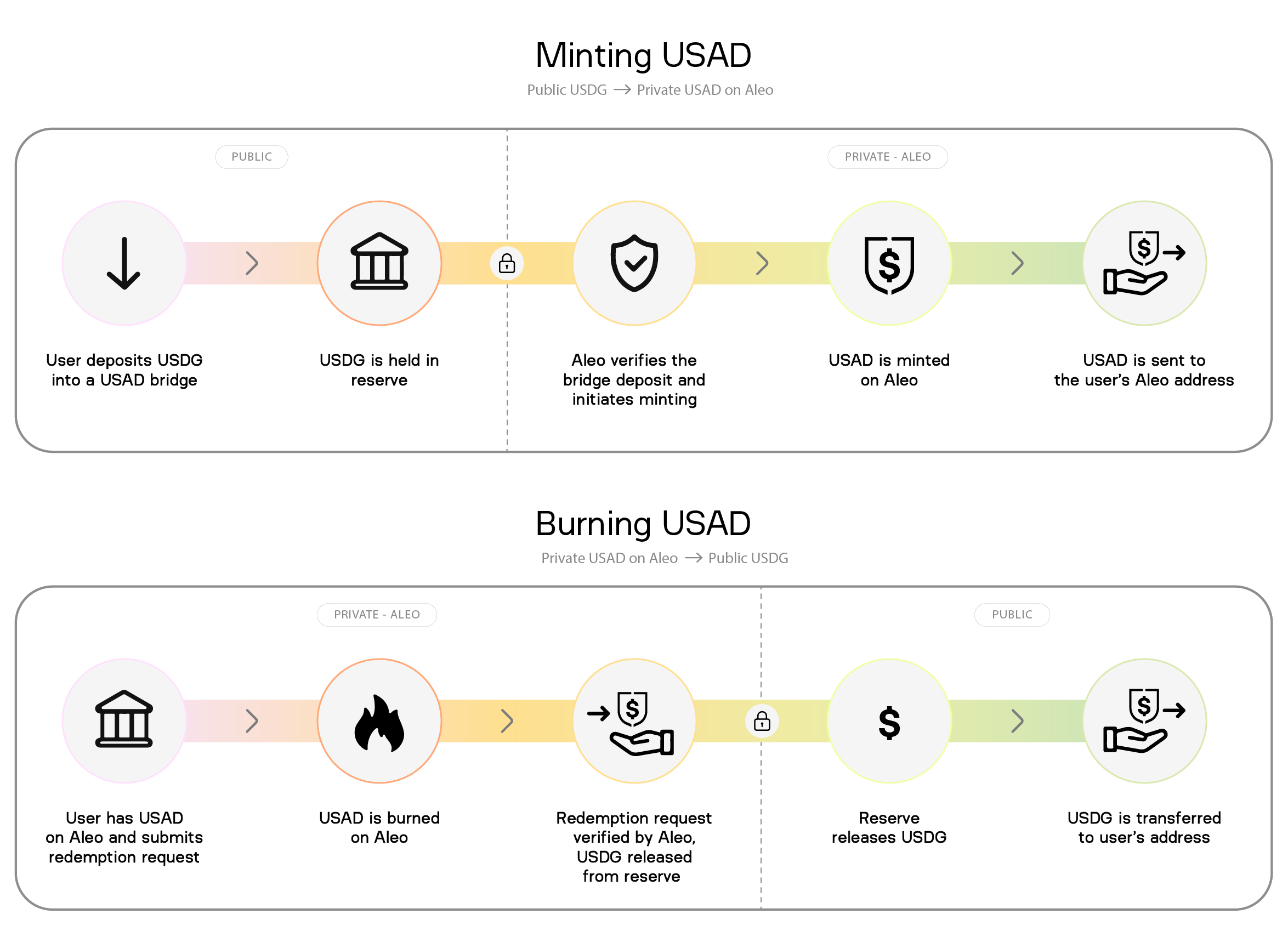
USAD is a US dollar-pegged stablecoin issued by Paxos Labs on Aleo’s zero-knowledge blockchain. It’s backed 1:1 by USDG, the reserve token of Global Dollar Network, which is issued by Paxos Trust Company and held in segregated, bankruptcy-remote accounts backed by US dollar deposits and short-term US Treasury securities.
What makes USAD different from every other stablecoin isn’t just the privacy: it’s where the privacy comes from.
“Privacy is the missing link in blockchain adoption at scale, and with USAD we are proving it can exist in a programmable stablecoin.” — Leena Im, Executive Director, The Aleo Network Foundation
Aleo is a Layer 1 blockchain built for private, programmable applications. At its core is zero-knowledge proof technology: cryptography that lets the network verify that a transaction is valid without revealing the underlying data. This means balances stay hidden, counterparties remain confidential, and transaction amounts are encrypted. It’s not a workaround or a bolted-on feature. It’s how the network functions by default.
USAD inherits all of that. Every transaction is encrypted end-to-end, with wallet addresses, amounts, and sender and receiver information all remaining hidden. Because of this architecture, participants can selectively disclose information to auditors or regulators when needed, without making anything else public.
From theory to paycheck: Toku builds the first private stablecoin payroll
USAD wasn’t designed to stay hypothetical. From the start, it was built to serve as a foundation for real financial applications. The first proof of that is already live.
Toku is a global compliance platform that has processed more than $1 billion in token payroll volume. Its platform lets companies run compliant stablecoin payroll through their existing HR systems — including ADP, Workday, UKG, and Gusto — via a simple API integration. In January 2026, Toku launched the world’s first fully private stablecoin payroll solution, built on USAD and Aleo’s privacy infrastructure.
Toku handles all the compliance complexity, including employment contracts, tax obligations, statutory benefits, and regulatory filings across 100+ jurisdictions. Aleo provides the private settlement layer behind the scenes. Employees receive their salaries in USAD with complete privacy.
No salary information is visible onchain, no treasury movements are exposed, and the company’s financial data stays confidential. The diagram below demonstrates the efficiencies that private stablecoin payroll unlock.
Crucially, Aleo and Toku didn’t just build this and ship it. They used it themselves first.
Before launching to enterprise clients, both Aleo and Toku integrated the system to pay their own globally distributed teams: employees and contractors spread across North America, Europe, and Asia. Team members can now opt-in to receive salaries in stablecoins, with instant access to dollar-denominated currency and no sacrifice of personal financial privacy.
What USAD makes possible
Toku’s payroll platform is the first major application built on USAD, but it’s designed to be the foundation for much more. Because USAD is programmable, developers can build private financial applications on top of it using Aleo’s Leo programming language.
The use cases that USAD unlocks include:
- Confidential payroll: Pay a global workforce instantly in stablecoins without exposing salaries, bonuses, or compensation structures to the public or to colleagues.
- Private treasury management: Manage corporate reserves and fund movements securely, with built-in auditability for regulators without public exposure of financial strategy.
- B2B payments: Settle vendor invoices and supply chain transactions onchain without revealing pricing, contract terms, or commercial relationships to competitors.
- Cross-border transfers: Send dollar-denominated payments internationally with the speed of blockchain, the stability of a regulated stablecoin, and the confidentiality of a private transaction.
- Private DeFi: Access DeFi protocols without exposing wallet balances or trading history.
Across all of these, USAD’s approach to compliance holds. Aleo’s zero-knowledge architecture lets participants cryptographically prove they’ve met regulatory requirements without exposing the underlying transaction data. The beauty is that privacy and compliance aren’t in tension: they’re engineered to coexist.
“Privacy is becoming table stakes for enterprise adoption..In order for stablecoins to move beyond experimentation, they need to fit into real business workflows. ” — Bhau Kotecha, Co-founder, Paxos Labs
Get started with USAD
USAD is live on Aleo mainnet today. Whether you’re an enterprise looking to modernise your payroll infrastructure, or a developer interested in building private financial applications, USAD provides the foundation.
Explore USAD on Aleo at aleo.org/usad. If you’re interested in private stablecoin payroll, book a demo at toku.com. Developers can explore Aleo’s developer documentation and the Leo programming language to start building.
Follow Aleo on X: @AleoHQ | Follow Aleo on LinkedIn: linkedin.com/company/aleohq/ | Join the Discord: discord.gg/aleo